
Summary:
If your yard floods after every storm and stays wet for days, you already know something is wrong. What most Nassau County homeowners don’t know is why — and that “why” matters more than almost anything else when it comes to choosing the right fix. The soil under your lawn in Elmont, Valley Stream, or Hempstead behaves completely differently from the sandy soil you’d find near the South Shore coast, and a drainage solution built for one can fail badly in the other. This guide walks you through what actually works, what doesn’t, and why the difference between clay and sandy soil changes everything.
Drainage Solutions for Nassau County's Clay-Heavy Soil
Most of inland Nassau County sits on glacially deposited soil — layers of clay, silt, and compacted earth left behind thousands of years ago. It doesn’t drain the way people expect it to. Water moves through clay very slowly, which means the ground saturates quickly and stays that way long after the rain has stopped.
This is why you can have a perfectly graded yard and still end up with standing water. The issue isn’t always the slope — it’s the soil’s inability to absorb and move water fast enough. Once you understand that, the logic behind different drainage approaches starts to make a lot more sense.
How French Drains Work in Clay Soil
A French drain is one of the most effective tools for clay-heavy soil, and there’s a straightforward reason for that. Instead of relying on the surrounding soil to absorb water, a French drain intercepts it. A gravel-filled trench with a perforated pipe at the bottom collects water before it can pool on the surface and redirects it toward a discharge point — a street drain, a dry well with a supplemental outlet, or a lower area of the property.
The key word there is “intercepts.” Clay soil makes absorption-based solutions unreliable because the ground simply can’t keep up with heavy rainfall. A French drain sidesteps that limitation entirely by moving water laterally rather than expecting it to soak straight down.
That said, not all French drains are built the same. In clay-heavy areas like Elmont or Garden City, the quality of the installation matters significantly. The gravel grade needs to be right — coarse enough to allow water to flow freely but not so large that fine sediment slips through easily. And geotextile filter fabric around the pipe and gravel isn’t optional in clay soil; it’s what separates a system that lasts 30 years from one that clogs in five. Without it, clay particles migrate into the gravel over time, slowly choking the system until it stops working.
A properly installed French drain also needs enough slope to function by gravity — at least one inch of drop per eight linear feet. That sounds minor, but on flat Nassau County lots, it requires careful planning. Many older homes in communities like Floral Park or New Hyde Park were built with minimal grading attention, which means drainage systems need to be engineered around existing conditions rather than ideal ones.
Do Permeable Pavers Help with Yard Drainage?
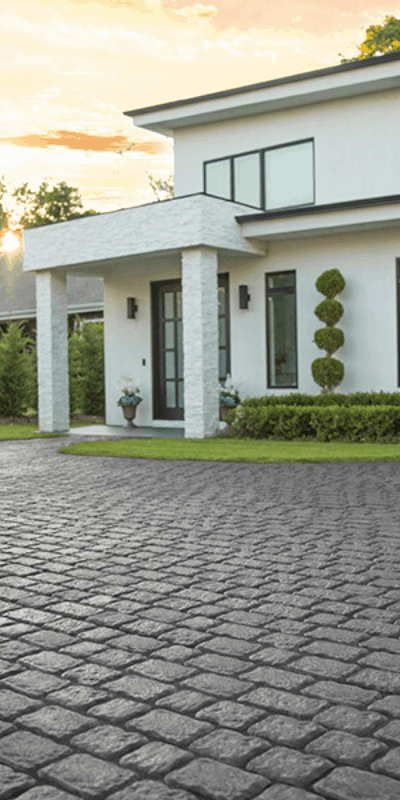
Permeable pavers don’t get nearly enough credit as a drainage solution, especially in Nassau County where hardscape runoff from driveways and patios contributes significantly to yard flooding. The concept is simple: instead of water sheeting off an impervious surface and concentrating in one area, it filters down through the joints between pavers into a prepared gravel base below.
For a driveway or patio that currently channels water toward your foundation or into a neighbor’s yard, switching to a permeable paver system can meaningfully reduce the volume of runoff reaching problem areas. It doesn’t eliminate the need for a subsurface drainage system in severe cases, but it removes a major source of concentrated water before it ever becomes standing water.
There’s another reason permeable pavers make particular sense in Nassau County: freeze-thaw cycles. The region sees dozens of freeze-thaw cycles every year, and traditional concrete surfaces take a beating from that. Water that pools on an impervious surface freezes, expands, and damages the material from below. With permeable pavers, water drains through rather than sitting on top, which dramatically reduces that freeze-related stress. Cambridge ArmorTec pavers are engineered specifically for this — manufactured to the highest strength and lowest water absorption levels possible, and backed by a transferable lifetime warranty that holds up through Long Island winters.
The base system matters as much as the pavers themselves. A proper permeable installation requires 8 to 12 inches of compacted crushed stone beneath the paver layer in freeze-thaw climates. That depth isn’t arbitrary — it’s what prevents frost heave from shifting the surface over time. Cutting corners on the base is one of the most common reasons permeable paver systems fail prematurely, and it’s worth asking any installer specifically how they’re handling sub-base depth before work begins.
Yard Drainage Solutions When Your Soil Is Sandy
Sandy soil — more common near Long Island’s South Shore in areas like Long Beach or Massapequa — drains quickly. Almost too quickly in some cases. Water moves through it fast, which eliminates most standing water problems but creates different challenges around soil erosion and plant health.
For properties with sandy soil, the drainage conversation shifts away from “how do we move water out” and toward “how do we manage where it goes.” Dry wells work well here because the surrounding soil can actually absorb what the well collects. Simple regrading is often enough to solve minor surface water issues. The solutions are generally less complex and less expensive than what clay soil demands.
Dry Wells and Catch Basins in Sandy vs. Clay Soil
A dry well is essentially an underground reservoir — water flows in, collects, and slowly percolates into the surrounding soil over time. In sandy soil, that percolation happens quickly and the system works well. In clay soil, it doesn’t. The surrounding ground can’t absorb water fast enough, so the dry well fills up during a heavy storm and loses effectiveness right when you need it most.
This is one of the most common and costly mistakes Nassau County homeowners make: installing a standalone dry well in clay-heavy soil and expecting it to solve a flooding problem. It might handle light rain. A nor’easter or a heavy spring storm will overwhelm it. If a dry well is part of your drainage plan in an inland Nassau County community, it needs a supplemental outlet — a connection to a French drain, a street drain, or another discharge point — so there’s somewhere for the water to go when the well fills.
Catch basins are a different tool entirely and work well in both soil types. A catch basin is a surface-level inlet — typically installed in a low spot or at the base of a slope — that collects surface water and routes it through an underground pipe to a discharge point. It doesn’t depend on soil absorption at all, which makes it reliable regardless of whether you’re dealing with clay or sand. For Nassau County homes where water consistently collects in the same corner of the yard after every rain, a catch basin is often the most direct fix.
The right answer for most properties isn’t one solution or the other — it’s a combination. Surface drainage (catch basins, channel drains) handles the water that arrives quickly during a storm. Subsurface drainage (French drains, properly connected dry wells) manages the groundwater that builds up over time. In clay-heavy inland areas of Nassau County, relying on surface drainage alone is like bailing out a boat without plugging the hole.
Landscape Drainage FAQs for Nassau County Homeowners
**How do I know if I have clay soil or sandy soil?** The quickest test is observation. After a rainstorm, does your yard drain within a few hours or does water sit for a day or more? Clay soil holds water visibly longer. You can also grab a handful of moist soil from a few inches below the surface — clay soil feels sticky and holds its shape when squeezed; sandy soil falls apart. Most properties in Elmont, Valley Stream, Hempstead, and the communities surrounding them are clay-heavy. If you’re closer to the South Shore coastline, you’re more likely to have sandy or mixed soil.
**What’s the most cost-effective lawn drainage solution for a Nassau County yard?** It depends on the severity of the problem. Minor grading issues — where water pools near the house because the ground slopes toward the foundation — can sometimes be resolved with regrading alone, which runs on the lower end of the cost spectrum. A mid-range French drain system for a standard Nassau County yard typically costs somewhere between $3,000 and $7,000 installed, depending on length and site conditions. Complex systems with multiple catch basins, pump assistance for flat lots, or significant excavation can reach $10,000 to $15,000 or more. The most expensive mistake is installing the wrong solution for your soil type — a dry well that fails in clay soil or a French drain without proper filter fabric that clogs prematurely.
**Do I need a permit for yard drainage work in Nassau County?** For most subsurface drainage work, yes — you’ll want a licensed contractor. Nassau County requires home improvement contractors to hold a valid license from the Nassau County Department of Consumer Affairs, along with proof of liability insurance and workers’ compensation coverage. That licensing requirement exists for a reason: improper drainage installation can redirect water onto neighboring properties, which creates liability. Always ask for license verification before hiring anyone for drainage work in Nassau County, NY.
**Can permeable pavers replace a French drain?** Not usually, but we’ve found they work well together. Permeable pavers reduce runoff from hardscape areas, which lowers the volume of water a French drain needs to handle. On properties where a significant portion of the drainage problem comes from paved surfaces, adding permeable pavers can meaningfully reduce the load on the subsurface system — and they improve the look of the property at the same time. They’re not a substitute for addressing saturated soil, but they’re a legitimate part of a well-designed landscape drainage strategy.
Getting Yard Drainage Right the First Time in Nassau County
The biggest takeaway here is that soil type drives everything. What works on a sandy lot near the South Shore will underperform or fail outright in the clay-heavy soil that covers most of inland Nassau County. A French drain needs filter fabric. A dry well needs a supplemental outlet. Permeable pavers need a proper sub-base. These aren’t optional upgrades — they’re what makes the difference between a drainage system that lasts decades and one that fails the first time a nor’easter rolls through.
If you’re still figuring out where to start, the most useful thing you can do is talk to someone who knows this area. Not a national website, not a generic contractor — someone who has been supplying drainage materials to Nassau County homeowners and contractors long enough to know what actually works here.
We’ve been at 747 Meacham Avenue in Elmont since 1956. Stop in any weekday from 7AM to 5PM, or Saturday from 7AM to 2PM, and talk to Pete or Steve. No sales pressure — just straight answers about what materials you need and why.