Summary:
Every spring, Nassau County homeowners walk outside and find the same thing: pavers that shifted, sections that sank, joints that opened up over winter. It’s frustrating, and it feels like a product problem. It almost never is. The pavers are fine. The base underneath them isn’t. Getting the foundation right before a single paver is laid is the difference between a surface that holds up for decades and one that starts failing after the first hard winter. Here’s what that actually looks like — and why Long Island’s soil makes this more important than people realize.
Paver Base Fundamentals for Long Island's Sandy Glacial Soil
Long Island was shaped by glaciers, and Nassau County’s soil reflects that history. What sits beneath most lawns and driveways here is sandy glacial outwash — highly permeable, fast-draining, and structurally weak under load. It doesn’t compact the way denser soils do, and it migrates over time, especially when water moves through it repeatedly.
That matters because a paver base isn’t just gravel you throw down before laying stone. It’s a structural system. You need angular crushed stone — not round pea gravel, which shifts — compacted in layers, with a geotextile fabric underneath to keep the sandy soil from working its way up into the base over time. Skip the fabric here and you’re borrowing time, not solving the problem.
The standard depth for a patio or walkway is four to six inches of compacted crushed stone, topped with exactly one inch of bedding sand. Driveways need more — eight to twelve inches of base is typical, with total excavation often reaching twelve to fourteen inches. These aren’t arbitrary numbers. They exist because Nassau County’s freeze-thaw cycle will find every weakness in an undersized base, usually within the first winter or two.
Paver vs. Concrete: Which Actually Holds Up Better Long-Term?
Concrete is cheaper to install. That part is true. In Nassau County, a professionally installed concrete patio or driveway typically runs five to fifteen dollars per square foot depending on finish, while pavers land between sixteen and twenty-two dollars per square foot installed. If you’re only looking at the invoice, concrete wins.
But that comparison falls apart quickly when you factor in what happens over ten to twenty years on Long Island. Concrete is rigid. It doesn’t flex. When the ground beneath it shifts — and in Nassau County’s freeze-thaw climate, it will — concrete cracks. Those cracks don’t patch cleanly. You either live with the look or you replace full sections, which means visible seams and color mismatches that never quite go away.
Pavers are individually replaceable. If one sinks or cracks, you pull it, address what’s underneath, and reset it. The repair is invisible. More practically, pavers are rated to a minimum compressive strength of 8,000 psi under ASTM standards — roughly four times stronger than a standard concrete slab. That strength, combined with the flexibility of an interlocking system, is why a properly installed paver surface can last twenty-five to fifty years with minimal maintenance.
There’s also the drainage angle. Pavers allow water to move through the joints and into the base rather than pooling on the surface. In areas near the south shore — communities like Oceanside, Rockville Centre, or Long Beach, where water tables run high and drainage is already a challenge — that matters more than most homeowners initially consider. A concrete surface sheds water to the edges. A paver system manages it from underneath, which is the right direction for Nassau County’s conditions.
The honest answer is that pavers cost more upfront and less over time. If you’re planning to stay in your home, the math is straightforward.
Asphalt vs. Paver Driveway: What Nassau County Homeowners Should Know
Asphalt is the default driveway choice for a lot of Nassau County homeowners, mostly because it’s familiar and the upfront number is low — typically four to six dollars per square foot installed on Long Island. A standard two-car driveway in asphalt might run three to four thousand dollars. The same driveway in pavers is closer to ten to thirteen thousand. That gap is real and it’s fair to acknowledge it.
What doesn’t get acknowledged as often is the ongoing cost of asphalt. It needs to be sealcoated every two to three years to prevent oxidation and cracking. It softens in summer heat — a genuine issue during Nassau County’s humid July and August — and becomes brittle in winter. After fifteen to twenty years, it typically needs full repaving. Add up the sealcoating cycles, the crack repairs, and the eventual replacement, and you’re looking at ongoing maintenance costs over a twenty-five year period, on top of the original installation.
Pavers, by comparison, require almost no ongoing maintenance beyond occasional joint sand replenishment. They don’t soften in heat or become brittle in cold. And in neighborhoods like Garden City, Manhasset, or Great Neck — where curb appeal directly affects property values — a paver driveway reads differently than asphalt from the street. Real estate data consistently shows quality driveway paving adds five to ten percent to home value, with some properties seeing gains up to twenty thousand dollars.
The other thing asphalt can’t do: individual repair. When asphalt fails in one section, patching it leaves a visible mark. With pavers, you address the problem at the source, reset the affected stones, and the surface looks the same as the day it was installed. That repairability is part of what makes the base preparation so important — when the base is done right, you’re rarely going back in.
What Is Cheaper, Concrete or Pavers? The Real Cost Breakdown
This is the question we hear most often, and the honest answer depends on what timeframe you’re using. Concrete wins on day one. Pavers win on year ten, fifteen, and every year after that.
A 400-square-foot patio in Nassau County runs roughly six to nine thousand dollars in pavers installed, versus two to six thousand in concrete. That difference is real. But concrete in Long Island’s climate is working against physics from the moment it cures. The freeze-thaw cycles crack it, the ground movement shifts it, and repairs are cosmetically permanent problems. Pavers absorb that movement, drain water properly, and when something does go wrong, the fix is surgical rather than structural.
The framing that matters most: a bad paver base turns a long-term investment into a short-term expense. Full re-installation — excavation, re-grading, new base material, reinstalling the pavers — easily clears five thousand dollars. Getting the base right the first time isn’t an upsell. It’s the only version of this project that actually makes financial sense.
Concrete vs. Brick Pavers: Which Material Actually Fits Your Project?
When most people say “pavers,” they’re picturing one of two things: concrete pavers, which are manufactured and available in a wide range of colors, shapes, and finishes, or brick pavers, which are clay-fired and carry a more traditional, classic look. Both are legitimate choices. The right one depends on the project, the aesthetic, and how the surface will be used.
Concrete pavers are more versatile. They come in far more profiles, sizes, and surface textures — Cambridge Pavingstones alone offers dozens of styles — and they hold up well in high-traffic areas like driveways. They’re also more consistent in dimension, which makes installation more predictable. For a modern patio, a pool surround, or a driveway in a community like Bethpage or Massapequa where clean lines and contemporary finishes are common, concrete pavers are typically the better fit.
Brick pavers bring a warmth and character that’s harder to replicate. The clay-fired material develops a patina over time rather than fading, and in older Nassau County neighborhoods — think the north shore communities around Port Washington or the established blocks in Rockville Centre — brick pavers fit the architectural context in a way that manufactured concrete doesn’t always match. They’re also extremely durable, often outlasting concrete pavers by decades when properly installed.
Here’s the thing both have in common: neither performs well without a proper base. The paver itself is the visible part of the investment. The base is what protects it. Whether you’re working with concrete or brick, the foundation requirements are the same — proper excavation depth, angular crushed stone compacted in lifts, geotextile fabric, one inch of bedding sand, edge restraints, and drainage slope. The material on top changes. The process underneath doesn’t.
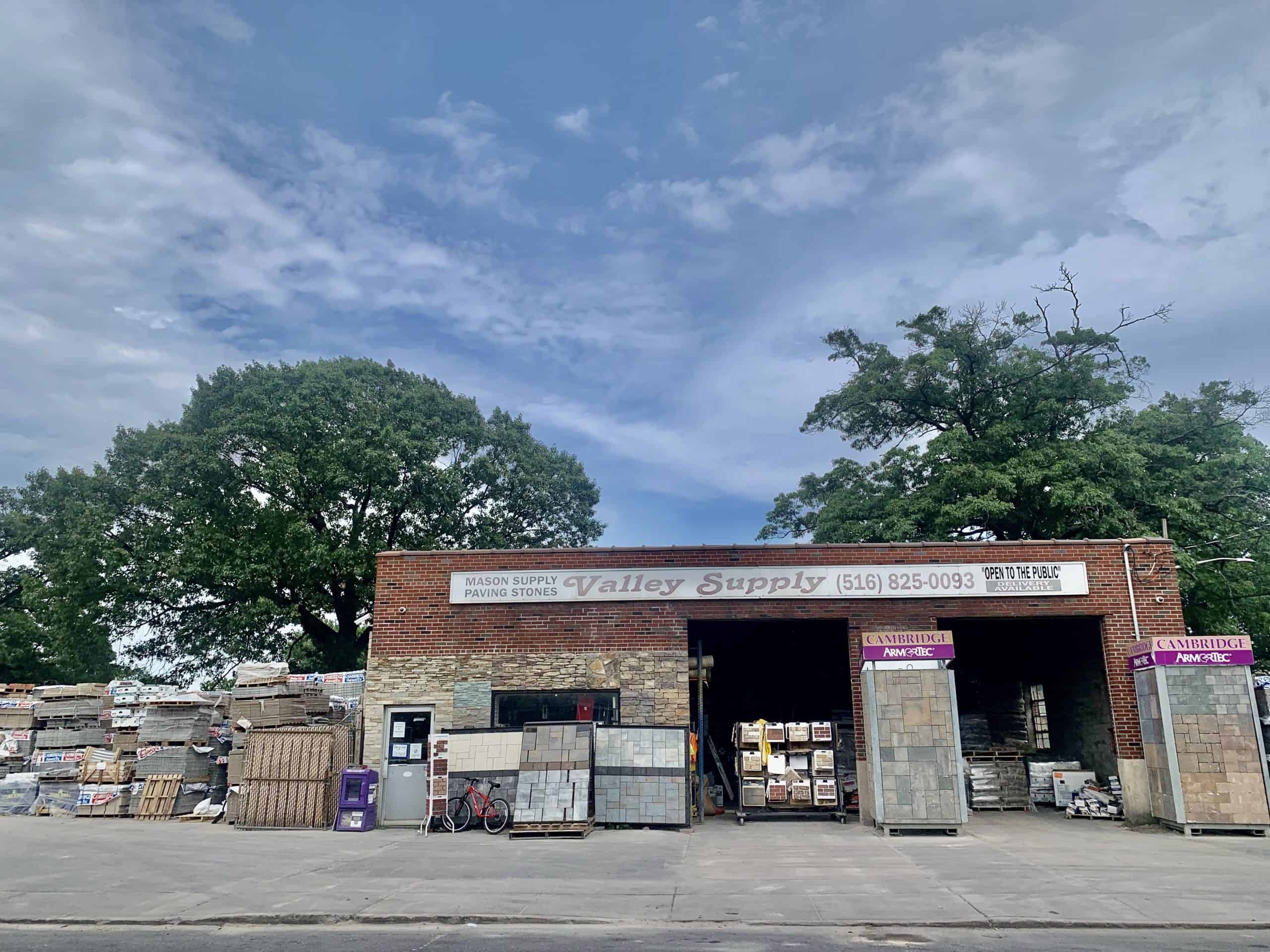
If you’re not sure which direction fits your project, that’s exactly the kind of question our team at Valley Supply has been helping Nassau County homeowners and contractors work through for nearly seventy years. We carry the full Cambridge line and can show you both options in person at our Elmont facility before you commit to anything.
FAQs Nassau County Homeowners Ask About Paver Base Materials
**Why are my pavers sinking after just one or two winters?**
In most cases, the base wasn’t deep enough or wasn’t compacted properly. The freeze-thaw cycle in Nassau County is relentless — temperatures cross the 32°F threshold multiple times throughout winter, and each cycle pushes water in the soil and base upward. If the base material wasn’t compacted in lifts, or if dirt was used as backfill (which can compress by up to thirty percent over time), the pavers have nowhere stable to sit. The fix usually means going back to the ground and starting over, which is why the base conversation matters before the first stone goes down.
**What’s the difference between paver base and paver sand?**
This is one of the most common and costly mix-ups we see. Paver base, in professional usage, refers to the structural layer of compacted crushed stone — the foundation that carries the load. Paver sand, or bedding sand, is the thin one-inch layer that goes on top of the stone base to allow fine adjustments in level before the pavers are set. Big-box stores often label bagged compactable aggregate as “paver base,” which adds to the confusion. Using the wrong material in the wrong layer — too much sand, or sand where stone should be — creates soft spots and uneven settlement. If you’re sourcing materials in Nassau County and aren’t sure what you’re looking at, bring your project dimensions to us and we’ll walk through the full material list with you.
**Do I really need geotextile fabric on Long Island?**
Yes — more so here than in most other regions. Long Island’s sandy glacial soil is permeable, which is good for drainage but means it migrates. Without geotextile fabric separating the native soil from your crushed stone base, that sandy soil gradually works its way up into the base layer, compromising the structure over time. It’s not an expensive material, and it’s not a difficult step. It’s also one of the first things that gets skipped when a contractor is cutting corners on price.
**How do I know if my contractor is doing the base correctly?**
Ask them what depth they’re excavating to, what base material they’re using, whether they’re compacting in lifts, and whether they’re installing geotextile fabric. A contractor who can answer those questions clearly and specifically is probably doing it right. One who gets vague or dismissive is worth pressing further. If you’re sourcing your own materials, knowing what proper base materials look like gives you a reference point for the conversation.
Where to Get Paver Base Materials in Nassau County, NY
The base is the part of this project that nobody photographs, but it’s the only part that determines whether the rest of it holds up. In Nassau County’s climate and soil conditions, there’s no shortcut that works long-term. The right depth, the right material, proper compaction, and a drainage plan — that combination is what separates a surface that looks the same in fifteen years from one that needs to be torn out and redone after the second winter.
We’ve been supplying masonry and paver base materials to Nassau County homeowners and contractors from our Elmont location since 1956. As a Cambridge Premier Dealer for nineteen consecutive years, we carry the full material lineup — crushed stone, bedding sand, geotextile fabric, edge restraints, polymeric sand — and our staff can help you calculate exactly what your project needs before you load up.
If you’re planning a project or troubleshooting one that’s already showing problems, come see us at 747 Meacham Avenue in Elmont, or call us at 516-825-0093. We’re open Monday through Friday from 7AM to 5PM and Saturdays from 7AM to 2PM. We’re open to the public — no contractor license required, no pressure, just straight answers.