
Summary:
If your yard stays soggy for days after a rainstorm, or your pavers have started to sink and shift after just a few years, you’re not imagining things — and you’re not alone. This is one of the most common frustrations for homeowners across Nassau County, and it almost always comes back to the same root cause: the soil beneath your property doesn’t drain the way most people assume it does. Understanding why that happens — and what it actually takes to fix it — can save you from spending serious money on a project that fails before it should. Let’s start with the ground itself.
Understanding Nassau County's Clay Soil Drainage Challenges
Nassau County’s soil drainage problems didn’t start with your property. They go back roughly 20,000 years, to the glacial activity that shaped Long Island’s entire landscape. As glaciers retreated during the last ice age, they left behind two distinct soil environments: the glacial till deposits along the north shore, which contain significant clay fractions, and the outwash plains of the south shore, which are flatter and sandier on the surface but often hide clay-heavy subsoil beneath.
That flat topography is the other half of the problem. Much of central and western Nassau County — communities like Valley Stream, Elmont, Franklin Square, and West Hempstead — sits on terrain with slopes of 0 to 3 percent. Essentially flat. Water doesn’t move off these properties naturally the way it would on a hillside. It sits, saturates, and slowly overwhelms whatever drainage capacity the soil has left.
Why Nassau County Soil Holds Water Longer Than You'd Expect
Clay particles are microscopic and tightly packed, which means the void space in clay-heavy soil — the room available for water to move through — is typically less than 40 percent. Compare that to sandy soil, which can exceed 50 percent void space, and you start to understand why water moves so differently depending on where you are on Long Island. In practical terms, a percolation rate below one inch per hour signals a drainage problem that topsoil and regrading alone won’t fix.
There’s also a compaction factor that’s easy to overlook. Nassau County’s postwar housing boom — most of it concentrated in the 1940s and 1950s — left behind a legacy of heavily compacted subsoil. Decades of construction equipment, vehicle traffic, and foot traffic have pressed whatever natural soil structure existed into something closer to a solid barrier. Even properties that started with more permeable soil have often been compacted into something that behaves like clay over time.
And then there’s winter. Nassau County’s freeze-thaw cycle runs from December through March, and it’s genuinely destructive to any hardscape that wasn’t installed with drainage in mind. Water trapped in clay soil freezes, expands, and pushes upward with enough force to lift pavers, shift base materials, and crack concrete. Homeowners often notice the damage in spring and assume something failed during installation — but the real failure happened months earlier, during a site prep phase that didn’t account for what Long Island winters actually do.
The clay deposited on Nassau County’s bedrock was laid down approximately 70 million years ago during the Cretaceous period, according to the Nassau County Soil and Water Conservation District. It’s not going anywhere. No amount of topsoil amendment is going to change what’s happening three feet below your lawn. Any project that doesn’t account for what’s down there is working against the geology, not with it.

Soil Drainage Problems That Show Up After Installation — Not Before
Most clay soil drainage problems don’t announce themselves during construction. They show up two, three, or five years later — after the contractor is long gone and the warranty conversation feels awkward. Pavers that were perfectly level at installation start to sink in one corner. A patio that looked great in August develops frost heave by March. A driveway that seemed solid starts showing cracks along the edges where the base has shifted.
These aren’t random failures. They follow a predictable pattern that comes from skipping — or rushing — the base preparation phase. When a contractor excavates too shallow, uses the wrong aggregate, or skips geotextile filter fabric to keep the bid competitive, the clay soil beneath the installation eventually wins. It migrates upward into the drainage layer, clogs it, and the base starts behaving like the clay it was supposed to be separated from.
The financial stakes here are real. Paver patio installation ranges from $2,400 to $7,000 depending on size and materials. That’s not a small investment to watch settle and crack because the base was done wrong. And it’s not just the cost of the original project — it’s the cost of tearing it out and starting over, which is often more expensive than doing it right the first time because you’re paying for demolition on top of reinstallation.
What makes this particularly frustrating for Nassau County homeowners is that the problem is entirely preventable. The right base depth, the right aggregate, the right slope, and the right drainage layer make the difference between a hardscape that lasts 20 years and one that’s failing by year five. But you have to know what “right” looks like before the work begins — not after.
Site Preparation for Clay-Heavy Soil on Long Island
Proper site preparation on clay-heavy soil isn’t complicated, but it is specific. The margin for error is smaller than it would be in a sandier environment, and the consequences of cutting corners show up faster. Getting this right starts with understanding what the soil is actually doing — and designing the base layer to manage water even when the subsoil cannot.
The general standard for paver installation on clay soil calls for excavating 9 to 12 inches below finished grade — and in heavily clay-laden areas, going deeper is often the right call. That depth creates room for a properly engineered base that handles drainage before it ever reaches the clay layer beneath.
Soil Testing Before You Build: Why It Matters in Nassau County
One of the most commonly skipped steps in Nassau County hardscape projects is soil testing — specifically, a percolation test that measures how quickly water moves through your soil. Most homeowners associate perc tests with septic system permitting, but the same information is directly relevant to any patio, driveway, or retaining wall project where drainage will be a factor.
A percolation rate below one inch per hour means your subsoil cannot handle water infiltration at a useful rate. That single data point changes the entire design approach for a hardscape project. It tells you how deep the drainage base needs to be, whether a supplementary drainage system like a French drain or catch basin is necessary, and whether the project should be designed to redirect water entirely rather than rely on any percolation at all.
The Nassau County Soil and Water Conservation District provides technical services to landowners across the county and is a legitimate resource for understanding your specific soil conditions. Their data, combined with a site-specific percolation test, gives you actual numbers to work with — not assumptions based on what your neighbor’s yard looks like or what a contractor thinks based on a visual inspection.
It’s also worth noting that Nassau County’s soil varies significantly by neighborhood. The Hempstead Plains — one of the few natural prairies east of the Appalachian Mountains, formed by glacial outwash — has different surface characteristics than the glacial till areas closer to the north shore. Communities near the south shore bays, including Freeport, Oceanside, and Long Beach, face an additional complication: elevated water tables that compound clay drainage problems by pushing moisture upward from below at the same time rain is pushing it down from above. Testing before you build is the only way to know what you’re actually dealing with.
What Proper Base Preparation Actually Looks Like for Long Island Pavers
Once you know what your soil is doing, the base preparation approach becomes much clearer. For clay soil conditions, the standard open-graded base — angular clean stone that allows water to move through and out rather than pooling — is the foundation that makes everything above it work. This is different from compacted road gravel, which is cheaper and faster to install but traps moisture rather than draining it. That distinction matters enormously in a Nassau County winter.
Beneath that stone base, a geotextile filter fabric separates the aggregate from the clay subsoil. Without it, clay particles migrate upward over time, infiltrate the drainage layer, and gradually turn your open-graded base into something that behaves like the clay it was supposed to be isolated from. It’s one of the most commonly skipped components on lower-bid installations, and one of the most consequential omissions.
The base also needs to be sloped — a minimum of 2 percent grade — to direct water away from any structure on the property. On Nassau County’s nearly flat lots, that slope has to be engineered deliberately. It doesn’t happen on its own. And in areas where the percolation test shows the subsoil simply cannot absorb water at a useful rate, supplementary drainage — a French drain along the perimeter, a catch basin in a low spot, or a channel drain across a driveway — needs to be part of the design from the start, not added as an afterthought when water starts pooling after installation.
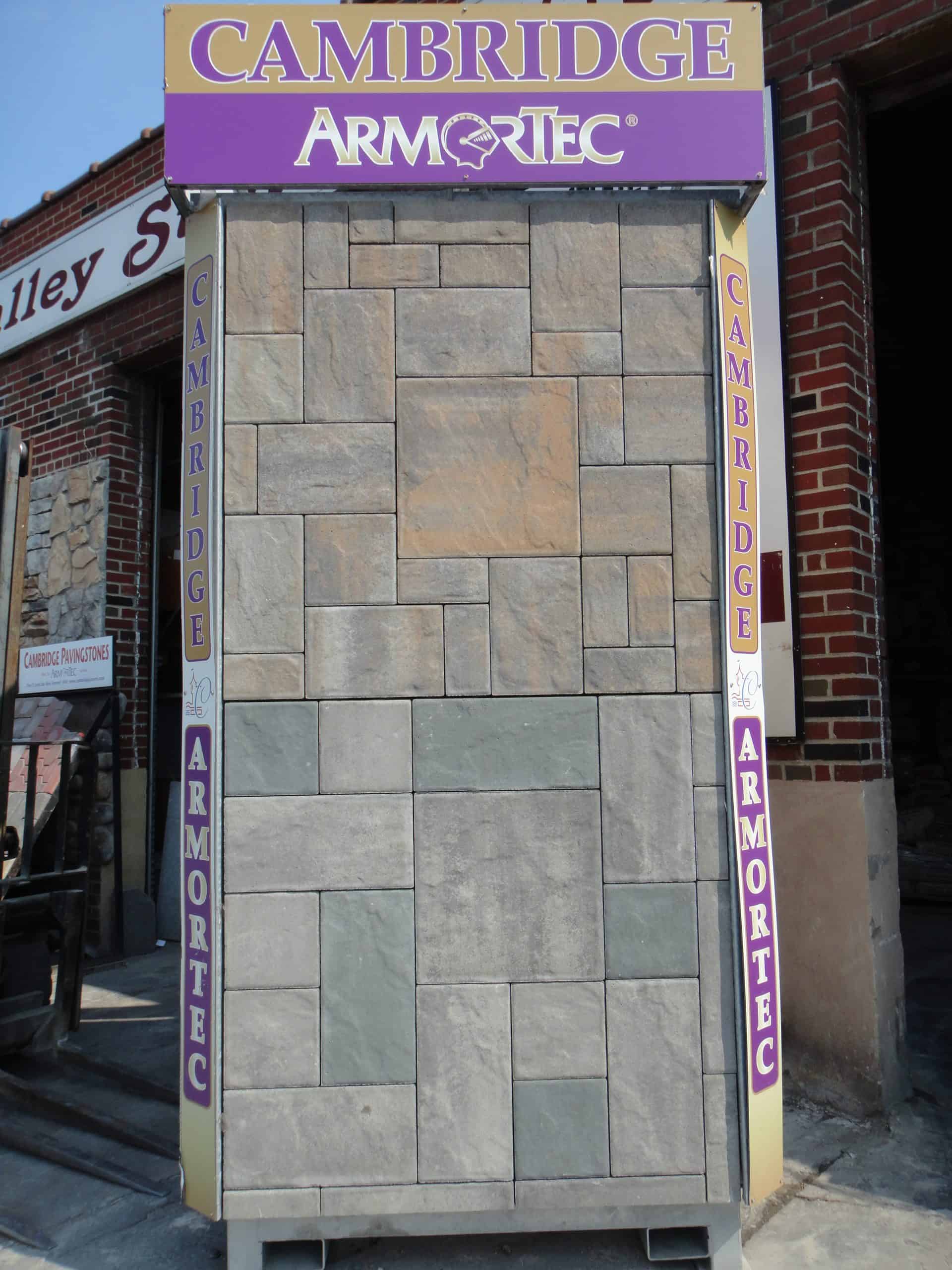
Cambridge Pavers, which we’ve carried for over 20 years as Nassau County’s Premier Cambridge Dealer, offer paving systems specifically engineered for these conditions. The open-graded base system Cambridge recommends is designed to manage water at the base layer even when the subsoil can’t keep up — which is exactly the situation most Nassau County properties present. The pavers themselves come backed by a transferable lifetime warranty, which means a properly installed project doesn’t just hold up; it adds documented value to your property if you ever decide to sell.
Working With a Nassau County Supplier Who Knows This Soil
Clay soil drainage isn’t a problem you solve by hoping the contractor gets it right. It’s a problem you solve by understanding what the soil requires before anyone breaks ground — and by sourcing materials from people who have been watching Long Island projects succeed and fail for a long time.
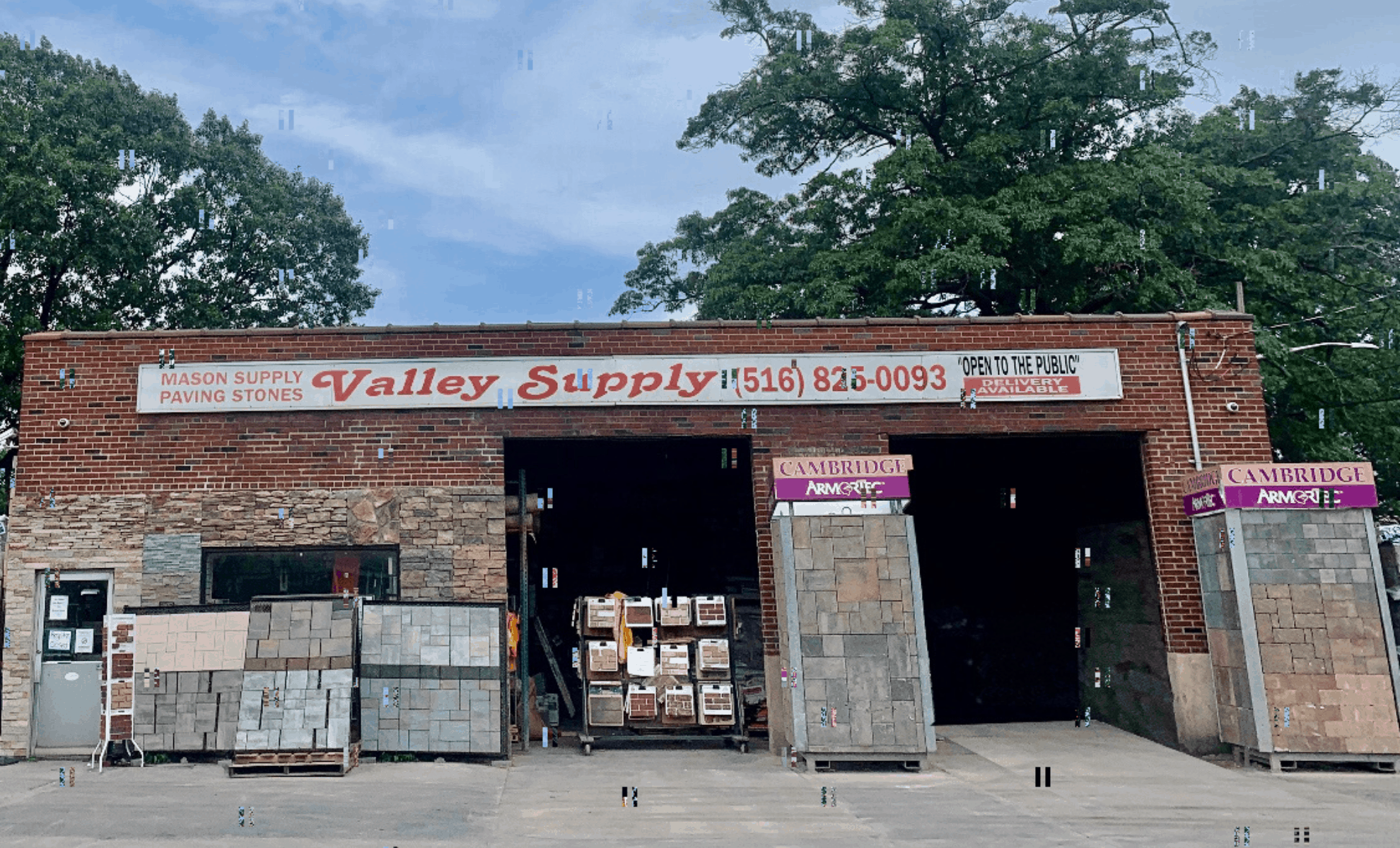
We’ve been at 747 Meacham Avenue in Elmont since 1956. Pete and Steve at our counter have more than 50 years of combined experience advising on projects across Nassau County and Queens — the kind of experience that comes from actually seeing what holds up through decades of Long Island winters, not just reading about it. When you come in, you’ll find hands-on displays across 20,000 square feet of showroom space, a full inventory of Cambridge Pavers and base materials, and straightforward answers to whatever questions you’re working through.
There’s no pressure here. If you want to walk the displays, ask questions, and leave with a clearer picture of what your project needs, that’s a perfectly fine outcome. We’re open to the public Monday through Friday from 7AM to 5PM and Saturdays from 7AM to 2PM — stop in when it works for you.