Summary:
If you’ve been researching brick pavers for your Nassau County home, you’ve probably noticed that most of the information out there is written for a generic audience — nothing about clay soil, nothing about freeze-thaw cycles, nothing about what actually happens to a patio in Elmont or Valley Stream after three Long Island winters. That gap is exactly why we created this guide. Whether you’re replacing a crumbling driveway, building out a backyard patio, or finishing a pool surround, the choices you make upfront — material, base prep, drainage — will determine whether your project lasts 10 years or 50.
Paver Installation Guide for Nassau County's Soil and Climate
Long Island’s soil is not forgiving. Much of western Nassau County — Elmont, Valley Stream, Franklin Square, Lynbrook — sits on glacial clay that holds water instead of draining it. Combine that with terrain that’s nearly flat and you have a recipe for pooling, erosion, and base failure if the installation isn’t done right from the start.
Freeze-thaw cycles make it worse. Water that seeps into a poorly prepared base freezes in winter and expands, exerting up to 25,000 psi of pressure on whatever is above it. That’s what causes pavers to heave, shift, and become uneven — not the pavers themselves, but what’s underneath them and how well water is managed.
What Does a Proper Paver Base Look Like in Nassau County?
The base is where most paver installations succeed or fail, and in Nassau County’s conditions, cutting corners here is what leads to the sinking and shifting that homeowners complain about a few years in. A proper installation starts with excavation — typically 8 to 10 inches deep for pedestrian areas like patios and walkways, and 12 to 14 inches for driveways that need to handle vehicle weight. That depth isn’t arbitrary. It accounts for the compacted aggregate base, the bedding sand layer, and the paver itself.
After excavation, a geotextile fabric goes down first. This is a step that gets skipped on budget jobs, and it matters significantly in Nassau County’s clay-heavy soil. The fabric acts as a separator, keeping your clean crushed stone base from slowly mixing with the native soil beneath it. Once that fabric is in place, compacted aggregate — not just gravel, not just sand — gets packed down to create a stable, load-bearing foundation.
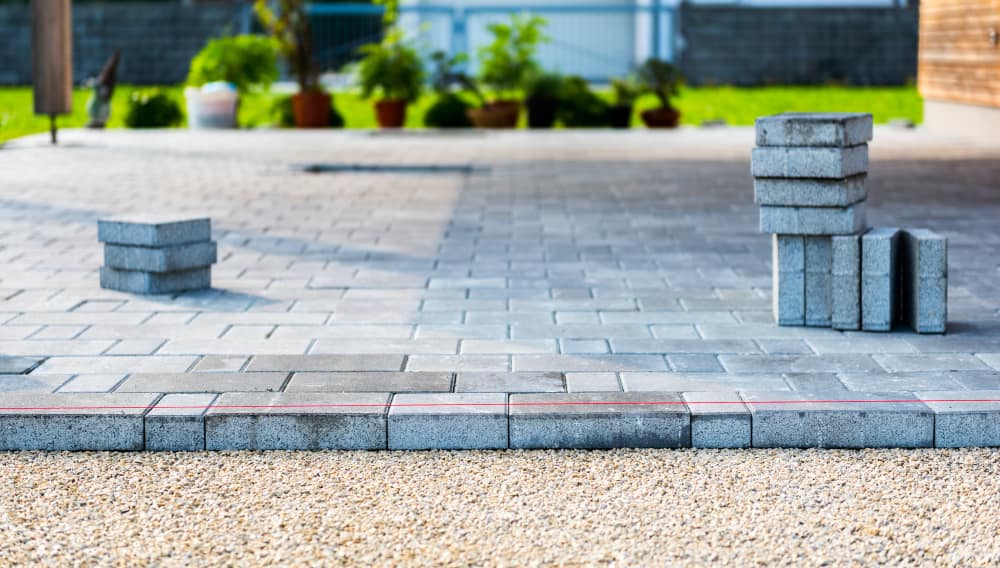
On top of that goes roughly an inch of bedding sand, which allows for final leveling before the pavers are set. Then the pavers go in, joints get filled with polymeric sand to resist weed growth and washout, and heavy-duty edge restraints are anchored along the perimeter to keep everything from spreading outward over time. That last part — the edge restraints — is something a lot of homeowners don’t think about until their patio starts to look like a jigsaw puzzle that’s coming apart at the edges.
Grading matters just as much as the base itself. A minimum 2% slope away from your home or structure is required to prevent water from pooling on the surface. On Long Island’s flat terrain, this doesn’t happen naturally — it has to be engineered into the installation. If your contractor isn’t talking about slope and drainage before a single paver goes down, that’s worth asking about directly.
Choosing a Brick Supply Company for Nassau County Projects
Most people focus almost entirely on the contractor and give very little thought to where the materials come from. That’s understandable — the contractor is the one showing up to do the work. But the quality of the pavers themselves has a direct effect on how well they hold up over time, especially in a climate like Nassau County’s.
Not all concrete pavers are made the same way. The difference between a generic paver and a Cambridge ArmorTec pavingstone, for example, is not just cosmetic. Cambridge’s ArmorTec surface is manufactured into the paver itself — not applied as a coating afterward. That means the surface won’t absorb water the way a standard paver will. In a freeze-thaw environment where water absorption is the primary driver of surface damage, that distinction is genuinely significant. Cambridge pavers meet ICPI and ASTM International standards, are skid-resistant per ASTM F1678, and carry a fully transferable limited lifetime warranty — meaning the warranty follows the property, not just the original buyer.
Where you source your materials also affects what you actually have access to. A big-box store carries a limited selection, and the staff typically can’t help you calculate quantities, flag potential problems, or advise you on what’s appropriate for your specific project. A dedicated masonry supply yard — particularly one that holds a Premier Cambridge Dealer designation — carries the full product line and employs people who have seen hundreds of projects like yours. We’ve been supplying Nassau County and Queens contractors and homeowners since 1956. Pete and Steve at our counter have more than 50 years of combined experience between them. When you ask a question, you’re getting an answer grounded in decades of real project knowledge — not a product description read off a tag.
We’re also open to the public, which matters more than it might sound. A lot of homeowners assume a masonry supply yard is only for contractors. It’s not. You can walk in, see the hands-on displays in our 20,000 square foot facility, pick up samples, get a materials estimate, and leave with a clear picture of what your project is going to take — without any pressure.
Paver Drainage Solutions for Nassau County's Flat Terrain
Drainage is the issue that Nassau County homeowners underestimate most. When you’re in a community like Valley Stream or Elmont where the land is essentially flat, water doesn’t move on its own. It sits. And when it sits on or beneath a paved surface long enough, it erodes the base, promotes mold and algae growth, and sets up the freeze-thaw damage cycle that shortens the life of any installation.
Good drainage isn’t something you add to a paver project — it’s something you plan for before a single stone goes down. That means grading, it means subsurface drainage where necessary, and in some cases it means choosing a paver type specifically designed to let water pass through it rather than run off it.
How Permeable Pavers Help Nassau County Homeowners Manage Water
Permeable interlocking pavers are exactly what they sound like — a paving system designed to let water drain through the joints and into a filtered aggregate bed beneath, rather than running off the surface. For Nassau County properties dealing with clay soil and flat terrain, this isn’t just an environmental feature. It’s a practical drainage solution that addresses a real and recurring problem.
A properly installed permeable system can reduce water runoff by as much as 100%. The aggregate bed beneath acts as both a drainage layer and a filtration system, allowing water to recharge the groundwater naturally instead of overwhelming storm drains or pooling against your foundation. From a structural standpoint, permeable pavers are engineered to handle both pedestrian and vehicular traffic — so you’re not trading durability for drainage performance.
Cambridge’s permeable paving options, including systems like the Holland Permeable XL, are available through our Elmont location and are worth serious consideration for any Nassau County homeowner whose yard holds water after a heavy rain. If you’ve ever watched a puddle sit in your driveway or patio for hours after a storm, that’s the problem a permeable system is designed to solve. It’s not a workaround — it’s the right tool for the terrain.

What Nassau County Homeowners Ask Most About Brick Pavers
**How much does brick paver installation cost in Nassau County?** Installed brick pavers in Nassau County typically run $17 to $22 per square foot, while concrete pavers generally fall in the $16 to $19 range. Full projects — a driveway, a patio, a pool surround — commonly land between $10,000 and $30,000 depending on size, material, and complexity. Those numbers reflect Long Island’s labor market, which runs higher than national averages. Materials alone, before labor, typically cost $2 to $4 per square foot for standard concrete pavers, with premium options running higher. Getting a clear materials quote before you engage a contractor is a smart first step — we can help with that at our counter.
**Do I need a permit to install pavers in Nassau County?** For most residential paver installations — patios, walkways, pool surrounds — a permit is not typically required in Nassau County. Driveways can be different depending on the scope of work and your municipality. What is required is that any contractor you hire holds a valid Nassau County Home Improvement License. Ask for that license number before anyone starts work. It’s a basic protection that too many homeowners skip.
**How long do brick pavers last?** Properly installed pavers can last anywhere from 25 to over 100 years depending on the material and how well the base was prepared. Concrete pavers typically fall in the 25 to 50 year range. Natural stone options can last significantly longer. The biggest factor isn’t the paver itself — it’s the quality of the base and the drainage underneath it. A premium paver on a poor base will fail. A standard paver on a well-built base will outlast most of the alternatives.
**Can I install pavers myself?** Smaller projects — a simple garden walkway, a dry-laid patio in a flat area — are within reach for a capable DIYer. Larger installations, driveways, anything involving significant grading or drainage work, are better left to a professional. The base preparation alone requires equipment and experience that most homeowners don’t have access to. What you can do yourself is the planning and material selection — and that’s where visiting our Elmont facility before any work starts pays off. Seeing the products in person, talking through the project with someone who’s done it hundreds of times, and walking away with an accurate materials list puts you in a much stronger position before a contractor ever shows up.
Where to Start Your Brick Paver Project in Nassau County
The decisions that determine whether a paver project holds up for decades or starts failing in a few years are mostly made before installation begins — in the material you choose, the base preparation your contractor commits to, and how seriously drainage is taken given Nassau County’s specific soil and terrain.
If you’re still in the research phase, the most useful thing you can do is see the products in person. Reading about paver styles and colors online only gets you so far. Walking through a facility, handling the material, and talking to someone who can answer specific questions about your project is a different experience entirely.
We’ve been that resource for Nassau County and Queens homeowners and contractors since 1956. Stop by 747 Meacham Ave in Elmont — we’re open Monday through Friday from 7 AM to 5 PM and Saturdays from 7 AM to 2 PM — and we’ll help you figure out exactly what your project needs.